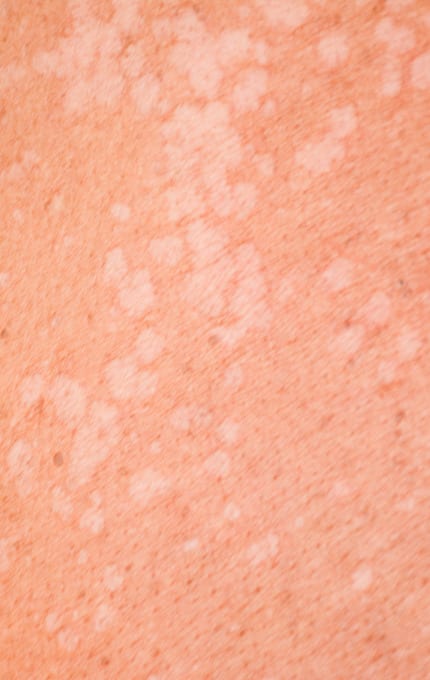
Versicolor tinea

Versicolor tinea is a fungal disease that does not cause visible inflammatory reactions on the skin. It belongs to the group of keratomycosis. The causative agent of the disease is Phitosporum orbiculare, which parasitize in the uppermost parts of the horny layer of the skin. The most vulnerable areas of the skin, susceptible to affection by versicolor tinea, are the areas of the chest, back, axillary cavity. If the disease is not treated for a long time, the foci can move to the shoulders, abdomen and side surfaces.

Statistically, versicolor tinea in our climate affects up to 5–10% of the population.

With versicolor tinea, yellow rashes are formed. In some cases, the places of inflammation are of dark brown colour. The fungus affects first of all the horny layer of epidermis, which leads to peeling of the skin areas affected by the pity scales. When scraping the skin, these scales easily separate, but with frequent washing, they are practically invisible. Under the influence of ultraviolet radiation, there is an intense peeling of the affected skin. This method in some cases contributes to the complete cure of the patient.
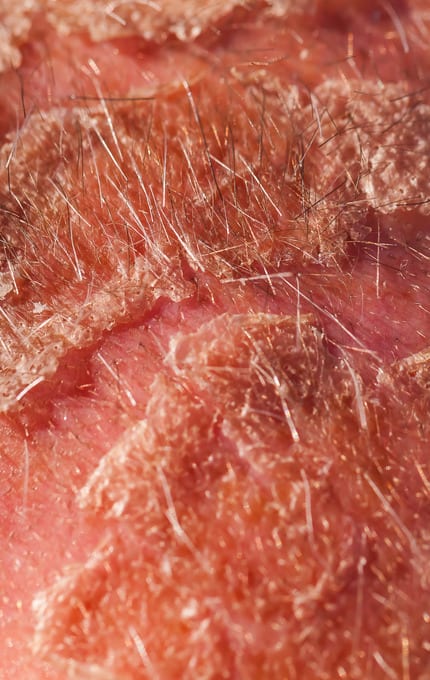
Seborrhea

Seborrhea or seborrheic dermatitis  is a chronic disease effecting primarily skin areas rich in sebaceous glands: the scalp, the auricles, the sternum, between the scapulae, in the nasal and nasolabial folds. The affected areas form a ring-shaped lesions. The disease is accompanied by peeling, inflammation, burning and itching of affected areas.

Seborrhoeic eczema first occurs in the scalp areas of the head, and then passes to the back, chest and face. This form of eczema is distinguished by the absence of sharp boundaries of affected areas, pronounced oozing, constant itching and the layering of scales of oily skin.

Seborheic dermatitis is often accompanied by a sharp decline in the functioning of the immune system. In addition, seborrheic eczema appears in patients affected by seborrheic dermatitis. At present, scientists are puzzled over the connection of seborrheic eczema with sinusitis, otitis, chronic diseases of the intestinal tract, neurological disorders.

Dandruff

Every second inhabitant of the planet is faced with the problem of dandruff at least once in a lifetime.

The causes of dandruff

Dandruff results from a combination of three factors:

  • A microorganism called Malassezia globosa, which lives on our skin
  • Natural scalp fat called sebum
  • Sensitive scalp

Malassezia yeast breaks down the scalp into oleic acid.

And in case of increased sensitivity of the scalp to the effects of this acid, which is observed in 50% of the world’s population, irritation appears, the symptom of which is dandruff.

When does dandruff appear?

Dandruff, as a rule, appears during puberty when the hormonal background associated with more intense secretion of the sebaceous glands. As a result of this, a rich nutrient medium is created for the microorganism Malassezia globosa, which is the main cause of dandruff.

Вut dandruff can also occur in other periods with hormonal changes: in adulthood or under the influence of stress.

Symptoms of dandruff

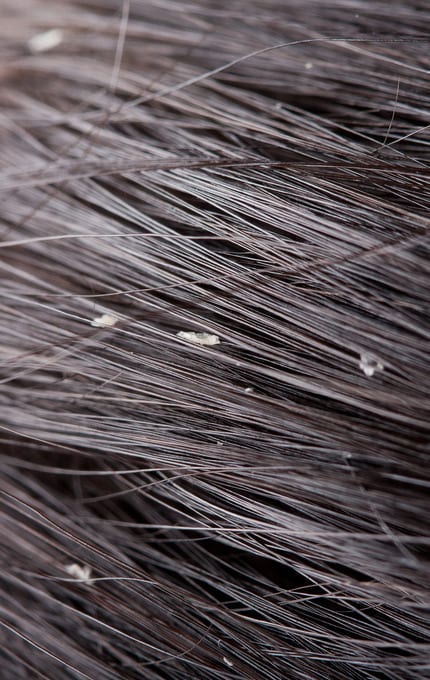
The simplest indicator of dandruff is white flakes of skin on the shoulders, but there are other signs:

  • Itching
  • Redness
  • Dry scalp

They can occur as a result of irritation as a reaction of sensitive scalp to the microorganism that causes dandruff.

How to get rid of dandruff

Fortunately, it is easy to deal with dandruff, white scales and dry scalp. To eliminate all symptoms, just wash your hair with anti-dandruff shampoo with proven effectiveness.

There are many different shampoos that are indicated for use depending on the specific symptoms, hair type and desired visible result of application — they will help to make the hair more thick and voluminous or smooth and silky.

All of them contain zinc pyrithione as an active substance, the effectiveness of which in the fight against dandruff with regular use has been proven by numerous clinical trials.